
Product Categories
 Multi-axis load cell
- Rod end load cell
- Cylindrical load cell
- Pancake load cell
- S type load cell
- Button type load cell
- Single point load cell
- Digital load cell
- Shear beam load cell
- Planar beam load cell
- Tension link load cell
- Tension sensor
- Through hole load cell
- Weighing module
- Special load cell
- Rotary torque sensor
- Reaction torque sensor
- Amplifier and instruments


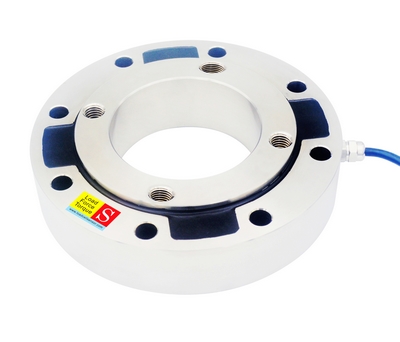
What is a reaction torque sensor (aka static torque transducer)?
Reaction torque sensors are designed to measure torque generated by a rotating or driven mechanism while the sensing body remains fixed to a supporting structure. Unlike rotary torque devices, the transducer housing does not rotate during measurement. Strain gauges are bonded to a precision-machined elastic element made from aluminum, alloy steel, or stainless steel. When torsional force causes slight deformation, the gauges detect the strain and convert it into an electrical signal through a Wheatstone bridge circuit.
A stationary torque transducer measures the reaction force produced when torque is applied to a shaft, actuator, valve, or other mechanical component. The sensor can detect clockwise and counterclockwise torque, making it suitable for bidirectional torque measurement and controlled testing. Its fixed-body configuration simplifies mechanical integration and eliminates the need for slip rings or rotating signal transmission components.
A static torque sensor is commonly used for applications where torque remains relatively stable or changes at a controlled rate. Typical uses include actuator and valve testing, torque wrench calibration, motor and gearbox testing, process control, container closure verification, fastening quality inspection, and performance testing of mechanical assemblies. Depending on the mechanical interface, flange-to-flange, shaft-to-shaft, and flange-to-square configurations can be selected for different test fixtures and installation conditions.
For applications requiring direct measurement of reaction forces within a fixed mechanical structure, a reaction torque load cell provides a compact and reliable solution. Proper alignment and rigid mounting are important to ensure that the applied torque is transferred correctly through the sensing element while minimizing unwanted bending or side loads.
LCS offers torque measurement solutions with capacities from 0.1 Nm to 10 kNm. Standard and customized designs are available with different mounting dimensions, materials, electrical outputs, cable configurations, and mechanical interfaces. For specialized torque testing equipment or OEM systems, custom development can be provided to match specific measurement ranges, installation constraints, and operating environments.